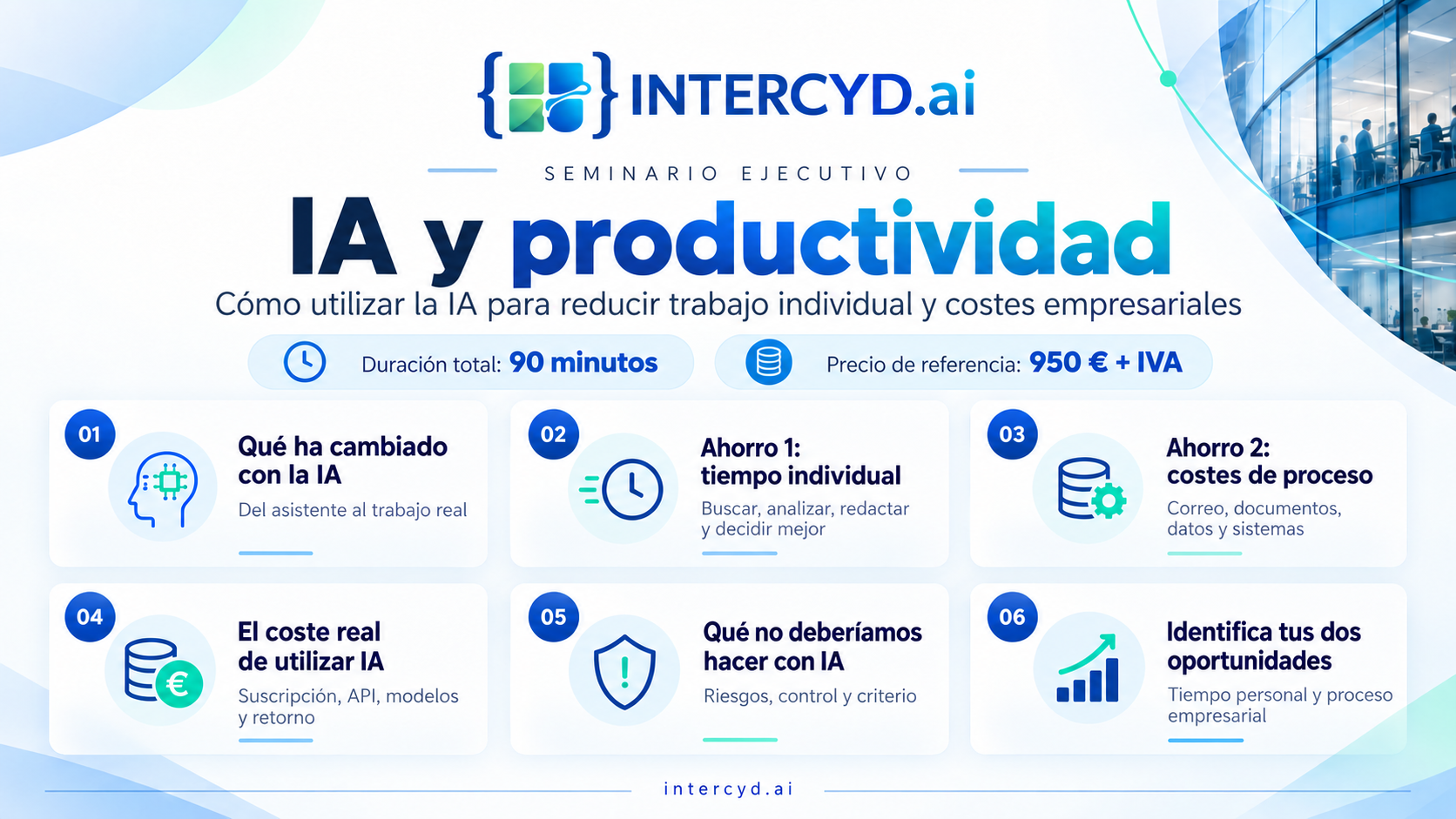
01
Executive seminar
€950 + VAT
Understand where the return is.
A session for management and business leaders: real cases, costs, risks and opportunities applied to your company.
We identify where time is being lost, quantify what is worth improving and build solutions that work with the email, documents, data and software your company already uses.
First we calculate where there is a return. Then we build.
You do not need to begin with a large transformation programme. Start by identifying opportunities, working with the team, measuring return or validating one process with a measurable pilot.
A session for management and business leaders: real cases, costs, risks and opportunities applied to your company.
A practical session with management and business leaders to identify tasks and processes where AI can reduce time, cost or operational load.
Organise a workshopWe analyse processes, hours, data and systems, delivering a prioritised map of impact, complexity, risks, estimated return and proposed pilots.
Assess my businessWe build a pilot around one specific process to measure feasibility, quality, integration and return before scaling.
Discuss a pilotWe integrate the solution, train teams and evolve the process so the result is sustainable.
See solutionsAutomation, integration, assistants, documents, data and applications.
Practical training for management and teams, applied to real day-to-day tasks.
Make an initial estimate of the capacity that a repetitive process could release. This is not a savings promise: it is a simple way to decide whether the process is worth analysing.
3 people spend 6 h/week on a process. Reducing that workload by 40% recovers around 346 hours/year. At €28/hour, that is close to €9,700 of annual capacity.
Indicative calculation based on 48 weeks/year. “Recovered capacity” does not necessarily mean accounting savings: it may become more output, better service or time for higher-value work.
Many companies do not need to start with a specific tool. They need to understand their processes better: where time is lost, where errors appear, what information is not being used properly and which tasks can be handled more efficiently.
Technology can accelerate a solution significantly, but only when there is judgement behind it: business understanding, technical experience, critical thinking and the ability to separate what matters from what is merely noise.
That is why our work is not about “adding AI”, but about designing useful, governable solutions connected to each company’s reality.
Not everything should be automated. We first identify the real problem and its impact.
Sometimes an integration is enough. Other times it makes sense to add artificial intelligence, document analysis or internal assistants.
Critical processes need validation, traceability and accountability, not black boxes.
We start from an operational problem and turn it into a clearer, measurable and controlled workflow. No unnecessary complexity: understand, design, automate, measure.
We review tasks, documents, people, systems, frequent errors and friction points.
We agree what should improve: time, errors, control, data quality or customer experience.
We choose the right combination of software, integration, automation and artificial intelligence.
We integrate the solution with the systems, data and teams already part of daily operations.
The goal is clear: less manual work, fewer errors, more control and greater operational capacity.
We work where companies handle documents, orders, emails, images, catalogues, business data or knowledge that is difficult to structure, search or reuse.
We extract and structure information from invoices, delivery notes, forms, contracts, receipts, policies, spreadsheets or PDFs to reduce manual work and improve control.
We turn product images, visual catalogues and commercial sheets into structured information, useful descriptions and knowledge bases prepared for sales or support.
We automate repetitive tasks, validations, reviews, statuses, notifications and incidents so teams spend less time on mechanical work.
We connect applications, online stores, ERPs, CRMs, intranets, databases, email and internal tools so information flows with less friction.
We create controlled query layers that allow users to ask questions over databases, ERPs, CRMs, intranets or internal systems using natural language.
We generate technical, commercial, comparative or executive documentation with clear structure, understandable language and professional formatting.
Artificial intelligence makes it possible to analyse, classify, summarise and generate information at unprecedented speed. At Intercyd AI, we direct that capability towards specific business processes: documentation, operations, administration, sales, internal knowledge and system integration.
Our approach combines technology consulting, process automation and applied AI to help CEOs, executive teams and business consulting firms reduce operational workload, improve traceability and make decisions with information that is more structured, reliable and actionable.
We apply AI to read, extract and structure information from documents, PDFs, images, emails, spreadsheets, catalogues and internal systems.
We design workflows where AI helps classify, summarise, compare, validate and prepare information within real business processes, not as an isolated tool.
We build internal assistants and solutions that help teams consult corporate knowledge, generate documents, analyse operational information and support faster decision-making.
We incorporate validation, traceability, human review and security criteria so that AI remains useful, controllable and aligned with business objectives.
We do not start from a single closed tool. We start from the problem and build a solution adapted to each organisation’s context.
Document intake, data extraction, validations, duplicate detection, expense classification, status control and integration with internal systems.
We organise product information, images, technical sheets and commercial documentation to support sales, support, internal search and commercial assistants.
We automate order intake, data normalisation, platform connection and incident management to reduce operational workload.
We create query layers that allow users to ask questions over databases, ERPs, CRMs, intranets or internal applications using natural language and safe queries based on a semantic business contract.
We process requests received by email, interpret Excel or BC3 files, extract line items, normalise concepts and prepare a reviewable economic base for faster budget preparation.
We transform technical, commercial or operational data into structured reports, comparative documents and client-facing materials ready to export, print or send.
Our experience combines software development, databases, system integration, business documentation, process automation, visual information analysis, language models, privacy and real management applications.
This cross-functional view allows us to design solutions that do not stop at a demonstration: they become connected to everyday business operations.
We organise, validate, connect and automate the information that matters.
Intercyd AI is a small team, and we deliberately want to keep it that way. We combine business experience, technology architecture and hands-on execution to solve real problems in operations, data and automation.
Hugo López, an entrepreneur with several active companies, brings something that cannot be learned from a manual: he knows first-hand the processes we solve because he has managed them himself. Francisco Llorens has spent more than twenty years building real business management systems, from the data layer to integration with operational processes.
For complex projects, we work with senior full stack profiles with long-standing experience. The team is completed by junior profiles with a strong technology orientation, bringing energy, curiosity and a genuine drive to solve real problems.
We do not start with technology. We first understand the process, the data, the constraints and the outcome the company needs.
The people who analyse the problem are involved in designing the solution. We reduce layers, noise and loss of context.
We do not come in to replace the client’s technical team. We complement it, accelerate the project and leave knowledge inside the organisation.
Intercyd AI helps organisations reduce manual work, organise scattered information, connect systems and improve process traceability. Our approach combines technology consulting, process automation, software development and artificial intelligence applied when it adds value.
We work on administrative processes, business documentation, orders, commercial information, catalogues, emails, spreadsheets, images, databases and internal knowledge. The goal is not to implement technology for trend reasons, but to achieve faster, more reliable, controlled and scalable processes.
Artificial intelligence can accelerate analysis, classification, data extraction or document generation, but human judgement remains essential to design the process properly and control the outcome.
We integrate solutions with existing systems: email, internal applications, online stores, ERPs, CRMs, databases, documents, catalogues and external platforms.
In an initial conversation we can determine whether there is a real opportunity, which data and systems are involved, and the right next step: training, assessment, pilot or implementation.
Request an initial conversationThis website is owned by INTEGRACIÓN DE SOLUCIONES TECNOLOGICAS, CONSULTORIA Y DESARROLLO, S.L. —Intercyd—, tax ID B21713995, registered address at Londres 38, Oficina 5, 28232 Las Rozas, Madrid, Spain. Contact: info@intercyd.ai · Phone: +34 91 829 85 08.
The website is informational and presents technology consulting, process automation, software development and artificial intelligence services applied to companies.
Browsing this website grants the status of user and implies acceptance of these terms. The user undertakes to use the website diligently, lawfully and in good faith.
The texts, design, structure, code, graphic elements, distinctive signs and contents belong to Intercyd or are used under sufficient authorisation or licence. Reproduction, distribution, public communication or transformation without express authorisation is prohibited.
Intercyd seeks to keep the published information correct, up to date and accessible, but does not guarantee the absence of errors, interruptions or unavailability. The information is general and does not constitute individual legal, technical, financial or professional advice.
The website may include links to third-party pages. Intercyd is not responsible for the content, policies or practices of those external sites.
This legal notice is governed by applicable Spanish and European regulations, including Law 34/2002, Regulation (EU) 2016/679 and Spanish Organic Law 3/2018.
For any query related to this website, you can write to info@intercyd.ai.
The data controller is INTEGRACIÓN DE SOLUCIONES TECNOLOGICAS, CONSULTORIA Y DESARROLLO, S.L. —Intercyd—, tax ID B21713995, registered address at Londres 38, Oficina 5, 28232 Las Rozas, Madrid, Spain. Contact: info@intercyd.ai · Phone: +34 91 829 85 08.
We may process data voluntarily provided by the user when contacting us, such as name, company, role, email address, phone number, message and any information included in the query. Technical browsing data may also be processed when the user accepts analytics cookies.
To handle information requests, respond to commercial or technical queries, prepare proposals, maintain communications related to requested services, manage pre-contractual or contractual relationships and, where accepted by the user, obtain aggregate website usage statistics.
The legal basis will be the application of pre-contractual or contractual measures requested by the data subject, legitimate interest in responding to communications and maintaining website security, compliance with legal obligations and, for analytics cookies, user consent.
Data will be retained for the time necessary to handle the request, maintain the relationship with the data subject and comply with applicable legal obligations. Data associated with analytics cookies will be retained according to the provider’s periods and applied configuration.
No data transfers to third parties are planned except under legal obligation. Providers necessary for technology services, hosting, email or analytics may access data, acting as processors where applicable.
The use of Google Analytics may involve international data transfers to Google LLC or related entities. Such transfers will be carried out under the safeguards provided by applicable law, including standard contractual clauses or other mechanisms recognised under the GDPR.
You may exercise rights of access, rectification, erasure, objection, restriction and portability by writing to info@intercyd.ai. You may also withdraw consent where processing is based on consent.
If you consider that the processing of your data does not comply with applicable law, you may lodge a complaint with the Spanish Data Protection Agency through www.aepd.es.
Cookies and similar technologies allow information to be stored or accessed on the user’s device. They may be necessary for website operation or used for measurement and analytics when authorised by the user.
This website uses technical local storage to remember the cookie preference selected by the user. This functionality is necessary to manage consent and does not require prior authorisation.
If the user accepts, Google Analytics 4 is activated through Google tag (gtag.js), with measurement ID G-4JT1YV97EM. Its purpose is to obtain aggregate statistics on website usage, pages visited, interaction and overall performance in order to improve content and navigation.
The analytics cookie provider is Google Ireland Limited / Google LLC, as applicable. Google may process data according to its own terms and privacy policies.
Analytics cookies are not activated until the user clicks “Accept”. If the user clicks “Reject”, analytics storage remains denied. Accept and reject options are displayed at the same level.
You can delete the saved preference by clearing site data in your browser. You can also block or delete cookies from your browser settings.
The use of Google Analytics may involve international data transfers. Google states that it applies recognised safeguards under European law, such as standard contractual clauses where necessary.
You can find more information about data protection in the privacy policy and about cookie management in your browser documentation.
A company was receiving administrative documentation on a recurring basis through email and other channels: invoices, delivery notes, supporting documents and files linked to projects. The process depended on manual review, classification, duplicate checks and subsequent entry into internal systems.
Scattered documents, manual status control, risk of duplicates and difficulty linking each file to the correct project, supplier or business process.
Design of a workflow for reception, classification, data extraction, validation and document traceability, integrated with a database and allowing human review whenever the extracted data is not reliable enough.
Use of AI to interpret documents, extract relevant fields, detect operational context and prepare structured data before validation or insertion into internal systems.
Less manual review, better document control, fewer errors and a traceable base to know what was received, when, from whom and how it was processed.
An organisation had a broad visual catalogue, with product images and commercial documentation that was difficult to exploit systematically. The objective was to transform that information into canonical records, useful descriptions and searchable commercial knowledge.
Product information distributed across images, catalogues, technical sheets and internal references, without a homogeneous structure for search, comparison or use by intelligent systems.
Creation of a process to analyse images and associated data, normalise attributes, generate structured records and prepare a commercial knowledge base.
Use of computer vision and language models to identify relevant information, generate concise descriptions and improve the commercial exploitation of the catalogue.
A more structured catalogue, reusable information, consistent descriptions and a base prepared for assistants, internal search tools or automated sales processes.
A company was managing a recurring volume of online orders that were not integrated with its internal system. Information had to be reviewed and manually re-entered, creating operational workload, delays and risk of error.
Orders received through an ecommerce platform, disconnected internal processes and the need for manual intervention to transfer information between systems.
Design of an integration using webhooks and endpoints to receive orders, record events, analyse data and progressively prepare their incorporation into the internal operational workflow.
The architecture allows AI to be incorporated in later phases to interpret incidents, classify orders, detect anomalies or assist with the validation of unstructured information.
Less manual entry, better order traceability, a technical base for progressive automation and stronger connection between ecommerce and operations.
Many companies have critical information distributed across databases, ERPs, CRMs, intranets or internal applications. However, answering new questions often requires technical intervention: identifying entities, understanding relationships, writing queries, validating filters and preparing a clear answer. The objective is to allow authorised users to ask questions in natural language and obtain answers based on real data, without directly exposing sensitive data to AI.
Data distributed across operational systems, complex relationships, non-obvious business logic and dependence on technical profiles to obtain reports, cross-checks or answers to questions not covered by existing dashboards.
Before generating queries, a contract is defined to explain to the AI what each entity represents, which relationships exist, which fields may be queried, which metrics are valid and which functional rules must be respected.
AI does not need to receive the data. It receives the semantic contract and the user question in order to propose a controlled query or retrieval plan, limited to allowed operations and aligned with the defined functional model.
The system validates the query before execution: read-only operations, allowed sources, result limits, absence of dangerous operations, required filters, user permissions and estimated execution cost.
The query is executed from the backend against the corresponding source —database, API, ERP, CRM or internal search engine— and then results, metrics, tables or summaries are presented in a way that is understandable for the user.
Less dependence on rigid reports, faster answers to business questions, better use of internal data and a more accessible query layer for leadership, operations or consulting teams.
In certain commercial or technical processes, budget requests arrive by email with Excel or BC3 files attached. Each request may have a different structure, line items with heterogeneous descriptions and varying levels of detail. The system transforms those files into a structured budget base and generates a final client-branded document, ready to review, export to PDF, print or send by email in just a few clicks.
The workflow starts from emails containing technical or financial attachments. The system identifies the request, registers the associated files and triggers the processing of Excel, BC3 or other related formats.
In Excel files, AI analyses the first rows to infer the structure: headers, relevant columns, descriptions, units, measurements, existing prices and possible groupings.
Extracted line items are transformed against a controlled model of families and subfamilies generated with AI support and functionally validated, allowing concepts written in different ways to be compared.
The system cross-checks normalised line items with internal purchase prices and available references. When there is not enough price information, it uses AI-assisted inference to estimate reasonable ranges.
To control cost, context and quality, line items without a price are grouped into work batches. AI returns minimum and maximum price estimates that support the technical review process.
The output is not just a data table: the system generates a presentable budget document with the client’s corporate image, ready for final review, PDF export, printing or email delivery in two clicks.
The system does not replace the final decision. It prepares line items, classification, price references, inferred ranges and a commercial document so the team can review, adjust and validate it before sending.
Less time spent preparing budgets, greater consistency between proposals, reduced manual work and a more professional delivery experience for the end client.
Many business processes generate valuable information that is not immediately usable for decision-making or client communication. Technical notes, operational data, commercial inputs and comparative information often need to be structured, explained and presented in a professional format before they can be sent, reviewed or approved.
Information was available across emails, spreadsheets, internal notes, project data or commercial inputs, but preparing a clear document for clients or management required manual editing and formatting.
Creation of a document generation flow that transforms structured and semi-structured information into branded HTML documents, ready to export as PDF, print or send by email.
AI helps summarise, compare, explain and organise information, while templates and business rules control the final structure, tone, sections and client-facing presentation.
Faster preparation of professional documents, more consistent communication, less manual formatting and materials ready for client review or executive decision-making.